Monday, December 7, 2009

horrible procrastination

Yesterday as I was sitting in the library, not working on one of the five papers that is due in the next week, I wasted time with one of my favorite middle school past times: online quizzes!

I took "Which Literary Character Are You Most Attracted To?" and got Pip. (Yeah, I know...) After I finished taking it, it occurred to me that it is book related, and thus blog-able for this site, but I felt like I needed to stop wasting even more time.
But now I want to share the quiz I took yesterday, because it's infinitely better than the one I took just now.
So here is the one I got Pip for (sorry, guys, I guess you could take the quiz and describe yourself in a relationship if you want to see who you'd be...): Which Literary Character Are You Most Attracted to?

That quiz seems absolutely quality compared to the one I took a few minutes ago. I've just completed "The Literary Character Test" and received the following results:

Your result for The Literary Character Test...

Juliette

You are...

Souless, heartless and decadent, Juliette is a character from her self-titled book by the infamous (and sometimes boring) Marquis De Sade. This woman profits immensely though her debaucheries, killing husbands, lovers and others while indulging in the flesh of the willing and not-so-willing. She is crafty and evil- the total opposite of her sister, Justine.


From "Juliette" by the Marquis De Sade

Take The Literary Character Test at OkCupid


I'm pretty disappointed, and also confused by the result. It doesn't help that I've never read Juliette (or even heard of it, for that matter). I'm also always astounded by the spelling/grammatical errors in these online quizzes, especially when they're about literary characters.

At any rate... if anyone needs an almost certainly dorkier than how you already procrastinate way to procrastinate, I recommend these corny online quizzes.

Thursday, December 3, 2009

pride & prejudice on twitter

The title of this post really says it all. I haven't read through this entire blog that presents Pride and Prejudice as a series of tweets, but what I've read so far is pretty funny.
http://madhattermommy.blogspot.com/2009/05/pride-and-twitterverse.html

I especially like this exchange between Bingley and Darcy in the first ball scene:

Bingley:
@Darcy I can hardly wait to dance with @JaneB. She is the most capital girl I have ever met. #loveat1stsight

Darcy:
@Bingley Any savage can dance. #proofofmysuperiority

Bingley:
@Darcy JaneB's sister, Lizzy is pretty. You could dance with her. It would be capital fun.

Darcy:
@Bingley She's tolerable, but she is not handsome enough to tempt me. Also: could you stop saying "capital" so much? #abovemypeers

Tuesday, December 1, 2009

there are some things we can never assign to oblivion, memories we can never rub away

I've been exploring some book blogs in hopes of finding one with posts I find interesting, and the Guardian Book Blogs offer some cool entries.

This post by Stephen Emms caught my eye because it's about a Japanese author I enjoy, Haruki Murakami:
http://www.guardian.co.uk/books/booksblog/2009/nov/27/falling-out-of-love-with-murakami.

Emms is basically suggesting that though he once loved Murakami's fantastical stories, he's now grown disinterested in the prolific writer. I'm a Murakami fan, but have read only three out of his massive 40+ collection of books. His writing (all in translation, of course, though it would be incredible to read them in Japanese) is strange and exquisite. Most of his novels feature parallel plots: the real world intersecting with a gloriously bizarre dream universe. I'm not a science fiction fan at all, and that's not how I would classify Murakami's writing - but it's not realistic like most of my preferred novels.

I understand Emms' complaints, and sort of agree with his statement below:

It's not the ever-modest Murakami's fault – his flight from Japan after the success of Norwegian Wood makes you wonder if he himself considers himself a little over-rated. It's just that his surreal tales about lost souls, with their inevitable choices between two different women, rather blur together.

The only thing is, I don't mind that his novels blur together in my head. Sure, it's embarrassing when I can't recollect if a particular plot point is from Hardboiled Wonderland and the End of the Universe or (my favorite Murakami novel) Kafka on the Shore, but that doesn't mean I like Murakami's writing any less because of it. I tend to respect that writers perfect certain niches. If they're doing them well, I don't mind slight repetition of themes throughout their works. It's my choice to read a Murakami novel when I'm in the mood for one. He is incredible at painting unbelievable scenes of crazy alternate worlds that speak to the truth of humanity in moving terms. And when that's what I want to read, that's where I go.

It's not that Murakami's range is even that limited. The first novel I ever read of his was a realistic novel - Norwegian Wood - and, at age 15, I loved it for its explicit love scenes and adult treatment of romance and sex. Murakami's writing can be tough to wade through, but I think it's rewarding when you're in the mood for a mind-blowing challenge.

Tuesday, November 24, 2009

childcare


Earlier today in Barnes & Noble, after peeking through Zadie Smith's new essay collection, I noticed Lorrie Moore's new book A Gate at the Stairs and decided to read the beginning. By the end of the first paragraph, I knew I had read it somewhere before. It is such a peculiar feeling to read something that you know you've seen before, but not be able to place how you know it if it's your first time reading this particular work. I placed it soon enough, though. Moore's new novel is an expansion of a short story called "Childcare" that she published in The New Yorker this past July.

Having liked the story when I read it a few months ago, I'm now more interested than ever in reading the complete novel. It's always a strange sensation to know there's more to a story than has been presented as a complete work previously. Just a reminder of how fiction is really fictional, and can be added to in any way the writer wishes.

At the top of this post is story's cover photo published in the July 6, 2009 issue of The New Yorker. After all, the title art is the first thing we notice.

Monday, November 23, 2009

and then the music touched her, making her skin prickle and her throat hurt


I am home! Sitting in my light drenched family room, listening to my mother's Ipod blast over the spacious hardwood floors. I am playing Annie Lennox, music of my childhood permeating through my childhood home.

So it is Thanksgiving break, early for me, because I came home to attend a wedding that was just perfect on Saturday. And here I stay. Anyways, over college breaks, I try to do some reading for fun. As I've mentioned before, winter break is the time to tackle the long projects. After visiting my sitster's bookshelf yesterday, I'm now considering attempting Swann's Way this winter break, but I'm not sure how feasible that is yet.

At any rate, last week I picked up two short story collections at Carnegie to read this week. As soon as I got home I immediately started catching up on the months of missed magazines (an ongoing project, as I will probably resume Entertainment Weekly back-issue reading over lunch today), so it wasn't until last night in bed that I read the first of those stories.

The collection is called Broccoli and Other Tales of Food and Love, and though it's not as potentially corny as the title suggests, it definitely is light reading, though Lara Vapnyar is a talented writer. I've never succumbed to the pleasures of "chick-lit," but I do sometimes enjoy high quality fluff reading. Two of my favorite somewhat mindless reads are The Girls Guide to Hunting and Fishing and Kissing in Manhattan. Broccoli and Other Tales of Food and Love is not as much fun as either of those two. But the first story I read did indeed contain many promising passages about the joys of vegetables. Which is why I chose this collection in the first place. I love food. And I love love.

While artistic attempts to combine the two powerful forces before have proved worse than uninspiring to me (see the unfortunate 2000 Penelope Cruz film "Woman on Top" for one example), I think that Vapnyar's collection has the potential to satiate my craving for fun, throwaway romantic and tasty reading this week. And what better week to read about food during. Thanksgiving is, after all, the most awesome food holiday of all time!

So I'll post again on my other collection of short stories soon... But now it is time to make lunch (reheating my mother's superb pasta carbonara with a side of broccoli rabe and a slice of banana cake for dessert).

Wednesday, November 18, 2009

it is the love that is the problem, people treat their lovers badly

More Zadie! My darling mother, knowing my affinity for Zadie Smith, was kind enough to forward me this NPR story about Smith's new book of essays: http://www.npr.org/templates/story/story.php?storyId=114173942&sc=emaf called Changing My Mind: Occasional Essays.

This new collection is exciting, because it's Smith's first major release that is not a novel. As a huge Lady Z fan, I'm nervous about her writing a book of essays. There is no doubt that I will read them. If anything, a book of personal essays about her various influences and how her upbringing with her father shaped her as a writer and a person should be more thrilling to me than a new novel because it allows a closer look at her life.

Even the interview filled me with appreciative exclamations as I was reading. "Oooooh, she's so smart" I kept alerting my roommate. It's true, though. Smith is exceptionally well-read. Here is an excerpt from the story that reveals her habits as a reader:

In "That Crafty Feeling," she confesses that, unlike novelists who avoid reading others' books while writing their own, "My writing desk is covered in open novels.I think of reading like a balanced diet; if your sentences are too baggy, too baroque, cut back on fatty Foster Wallace, say, and pick up Kafka as roughage."

Awhile ago one of the essays from this new book was published in The New Yorker. I was thrilled when I saw her name in that issue's table of contents, and reading about how her father's very British sense of humor impacted her taste was exciting. A whole book of those essays is bound to keep me enthralled.

I think Changing My Mind may have to be my winter break reading selection....

Tuesday, November 17, 2009

my favorite lepidopterist

Thanks to Maud Newton's blog, which I have to thank my professor for this class for recommending to me in the first place, I stumbled upon this really cool project:
http://observatory.designobserver.com/entry.html?entry=11597
21 designers were asked to create new versions new covers for all 21 of Vladimir Nabokov's novels. Called "The Specimen Box Project," because Nabokov was an avid butterfly collector, each book is presented in its own specimen box.
I love this because I'm a sucker for aesthetically pleasing copies of books I adore. Even though I know it's what is inside the cover that counts, I do think one day (when I'm an "adult" with spending money) I'd like to collect gorgeous copies of my most cherished books.
At any rate, looking at pictures of 18 of the 21 novels, I realize how much I need to read more Nabokov that isn't just Lolita - which isn't even pictured among the 18 shown.

My favorite new covers are The Enchanter, Glory, Pale Fire, but my very favorite is probably this one:

Monday, November 9, 2009

and besides, as a rule, things can't go back to what they were

There are many ways for a story to lose its original essence. Translations and adaptations are two common ways for a story to change, not necessarily in a good way.

In the case of The Master and Margarita, the Mikhail Bulgakov classic, various translations and multiple film adaptations have changed the shape of the novel a few times. I read the most recent translation of The Master and Margarita over the summer, and fell in love with it. This semester, after attending an English major advising appointment, I found an old copy of the book on a case in a spare room on the English floor of the Cathedral with a sign offering free books. There it was!
I love books, and I love free things, so free books are especially welcome.

Only upon closer investigation once I made it back to my room did I realize this was a 1967 translation that differed pretty significantly from the version I'd just read.

Because I'm currently lacking the energy to explain how difficult the plot of The Master and Margarita would be to adapt to a film (I am zapped of needed energy by what seems to be a nasty hollow aching in my chest, in conjunction to a burning pain in my throat that my mother insists is the swine flu), I am going to let this funny 70s narrator describe the difficulties as he introduces a 1972 film version of the novel.

I would recommend only watching until his introduction ends. The opening sequence is almost as painful as my symptoms. (Har Har Har)

Wednesday, November 4, 2009

With such stupid, purely physical, infirmities, that seem to depend on the sunset or something, how can one help doing stupid things?

Dostoyesvsky's 188th birthday on October 30th and I missed it! Thanks to Jessica Crispin at Bookslut, I can now acknowledge it properly. I never knew that he was born the day before Halloween.... But after reading Jessica's funny (and excellent, not that the two are mutually exclusive) post about it, I have an excuse to post about the Pittsburgh Irish and Classical Theater's production of Crime and Punishment that I saw at the end of September and neglected to mention on this blog.

I have read Crime and Punishment twice and, apart from my attempt to read Notes From Underground over this past summer, it is the only work of Dostoyevsky's that I've ever completed. I know how much of a shame that is, and given how much I loved C & P the second time I read it, I know I'd like his other novels a lot. The banter between Porfiry and Raskolnikov is exhilarating and the philosophical questions it raises are profound without feeling trite. And Dostoyesvky's characterization is sharp as all hell.
Take for example, this description of Peter Petrovich, Dunya's fiance:

Peter Petrovich belonged to that order of persons who seem extremely amiable in company and lay special claim to the social graces, but who, as soon as something is not to their liking, lose all their spring and become more like sacks of flour than animated and lively gentlemen.

This humor pervades the entire massive novel, though at parts it's much less funny than others.

The play adaptation I saw two months ago fails to capture many of those moments in the book. It would be impossible to adapt the whole novel to a 90 minute stage play, so the company chose to focus solely on Raskolnikov's meetings with Porfiry, and his relationship with Sonya. Those parts are all done well, but watching the play didn't knock me out as much as reading the book did. That said, the performances are strong and Joel Ripka depicted Raskolnikov's psychological struggles well. Thanks to a photo on the Pittsburgh Tribune site, below are Joel Ripka and John Meyers on stage as Raskolnikov and Porfiry during one of the invigorating interview scenes.


Sunday, November 1, 2009

And still, the box is not full

I know that we're supposed to be reaching out into the blogosphere this week, (and I promise, I've been looking into that!), but I've been thinking about East of Eden this weekend and I want to share a passage I loved in it that speaks volumes to the whole idea of this silly blog.
The selection I want to share describes the sensation of barricading yourself in a book. It's a feeling I miss a lot during the semester, when somehow I start viewing all free time as an opportunity to be doing something either more important, or more "fun" than reading for pleasure. That's a ridiculous and embarrassing fact for me to admit, especially here.

I'm looking forward to winter break for a lot of reasons, but one of them is definitely for whatever book I choose to bury myself in.

At any rate, here is the paragraph that triggered all of that:


"Tom got into a book, crawled and groveled between the covers, tunneled like a mole among the thoughts, and came up with the book all over his face and hands."

Tuesday, October 27, 2009

what we talk about when we talk about love

In keeping with the original intent of this blog (creating links within the literary world, showing how stories connect writers and collections...Six degrees of separation/Kevin Bacon basically), I thought I'd share how my recent reading of stories in My Mistress's Sparrow is Dead traces back to a Raymond Carver poem I found last week. A day after I found the poem I'm about to tell the story of, I was laying in bed choosing a story to end my night on from My Mistress's Sparrow is Dead. I chose the Raymond Carver short story "What We Talk About When We Talk About Love" because I'd read some of his stories before and find them intriguing.

But mostly I read it because only the day before....

...I was at Carnegie looking for a book of poems for my religion class, and I stumbled upon a collection of Raymond Carver poems. I never knew he wrote poetry, so I picked up the book, entitled All of Us to see what it was all (no pun intended) about. I'd already known that Carver's widow is named Tess Gallagher, so I shouldn't have been so shocked when I opened to a random page and saw the poem "For Tess".

But I was thrilled. And convinced that I'd just experienced some sort of poetry/name serendipity that had a much larger meaning than it did. I rarely see my name in print, and embarrassingly, I got real happy to see an entire poem written to me. It was a nice poem, too.

The last line reminded me a lot of a Nick Laird poem I love:

As I was lying there with my eyes closed,
just after I'd imagined what it might be like
if in fact I never got up again, I thought of you.
I opened my eyes then and got right up
and went back to being happy again.

I'm grateful to you, you see. I wanted to tell you.

Saturday, October 24, 2009

love drains from you

A few weeks ago I saw Lorrie Moore at the Drue Heinz Lecture Series in the Carnegie Music Hall. I'd never read any of her renowned short stories, but I had recently read a review of her newest novel A Gate at the Stairs, and figured if it were free, I may as well hear her speak.

At the talk, the woman introducing her relayed a story about how while Moore was getting her MFA at Cornell, the professor told them that using the second person to narrate a story was a cheap crutch. And so Moore decided to write a superb short story called "How to be an Other Woman" that went on to be featured in her collection of stories "Self-Help."

After seeing her talk, I went to the Carnegie Library to check out some of her stories, and saw that the story "How to be an Other Woman" was part of the Jeffrey Eugenides edited collection My Mistress's Sparrow is Dead, which is a book I've been wanting to read for a long time because of my love for Eugendies, and short stories. It's a collection of "great love stories, from Chekhov to Munro" and is chock-full of talented writers' stories. In his introduction Eugenides writes that it is only through reading love stories "that we can simultaneously partake of the ecstasy and agony of being in love without paying a crippling emotional price." Moore's story, written as a sarcastic instruction manual of sorts for how to have an affair, allows the reader to experience the self-loathing humiliation that being the other woman causes, without actually having to participate in an affair.

I'm glad to finally have this collection. And I'm glad to have seen Moore's talk. She reminded me of a text I'd been meaning to get for ages now, and in the process I discovered a new writer. I've added her new novel to my reading list.

Thursday, October 22, 2009

it's no use worrying about Time

Every morning I see a copy of a Frank O'Hara poem on my dresser. My sister printed it out for my birthday last year, and it immediately resonated with me. I already liked O'Hara's poetry a lot (thanks to my sister), but hadn't read this poem yet.

It's taken from O'Hara's collection "Meditations in an Emergency," which was featured on an episode of the AMC show "Mad Men" last year. At the time my sister gave me the poem, I hadn't yet seen "Mad Men," but now I have and completely adore it. So when I finally got to the episode from the start of season two in which the main character Don Draper recites the poem, I was beyond excited. Sure I was a year late in seeing it ("Mad Men" is now into its third season on AMC, but I'm only three episodes in...watching illegally online), but hearing my beloved Don Draper read the poem gave me chills.

Here is a clip of Don reading it out loud, followed by the poem. The real scene it's featured in is not available on Youtube, so this is just a compilation of different clips from the first two seasons with Don's voice over.


Now I am quietly waiting for the catastrophe of my personality to seem beautiful again, and interesting, and modern.

The country is grey and brown and white in trees, snows and skies of laughter always diminishing, less funny not just darker, not just grey.

It may be the coldest day of the year, what does he think of that? I mean, what do I? And if I do, perhaps I am myself again.


Saturday, October 17, 2009

max at sea

Last night I saw Spike Jonze's mega-hyped Where the Wild Things Are. I liked it. The visuals were spectacular, and the boy who plays Max could not have been better cast. His face is perfect in every shot, and my friend left the theater saying, "That is exactly how I want my son to be."
That said, I left the theater wondering why the wild things were so despairingly sad.

At the end of the summer I read Dave Eggers' story "Max at Sea" in the New Yorker, which I later found out was taken from the novel The Wild Things which is based on the screenplay Eggers wrote with Jonze for the movie. The story was fine, though I have yet to feel the same amount of adoration for Eggers' writing that I did after reading A Heartbreaking Work of Staggering Genius.
At any rate, last night as the movie began I was shocked by how closely the opening sequence matched the New Yorker story. It is fair to say that I preferred it on the big screen. But I'm still left wondering why the creatures Max encounters struggle with the tragedy that marks human existence. They were so so sad!

I read a New Yorker interview with Eggers where he talks about why he wrote a novel based on the beloved children's story. Here is what he said:

So it was a matter of probing deeper into who Max is, what he wants, what his life is like at home and at school. And on the island, looking deeper into who the Wild Things are and what they want from Max, his life as their king, and why he leaves. From the beginning, though, Maurice was clear that he didn’t want the movie or the book to be timid adaptations. He wanted us to feel free to push and pull the original story in new directions. Spike also gave me total leeway to make the book my own. He didn’t change a word, even though there were some things he was surprised by. That’s why we say the book is “loosely” or “very loosely” based on the movie.

I don't know if I would ever read this book.... I would definitely re-watch the movie, because it was gorgeous and entertaining (though, as I continue to dwell on, shockingly sad), but I feel like an adaption into a full length novel is a strange endeavor. The short story in The New Yorker featured just the right amount of what it feels like to believe you're utterly alone at age ten.

And, more importantly, (hah), I immediately ripped out the title page photo to bring to school for decoration. (My parents gave me permission to remove it, only after insisting that I photocopy the last page of the article on the opposite side of the photo...a story about electronic cars that I'm positive neither of them read).

Here is the photo currently next to my bedside. It alone gives an idea of just how lovable Max is in the film.


Monday, October 12, 2009

another Pittsburgh heartbreak

Yesterday was my 21st birthday. I fell asleep not having imbibed a single sip of alcohol, on my bed with my two young cousins (13 and 11) on the floor beneath me. I spent the weekend with my family, and felt filled with a contentment steeped in unnecessary and unjustifiable bittersweetness. Or, to phrase it better than that, and to borrow from Michael Chabon, a Pittsburgh writer's quote from his novel The Mysteries of Pittsburgh:

"But it was a happiness so like sadness that the next moment I hung my head"

Earlier in my birthday, before the three of us were falling asleep, I gave my aunt, uncle and their daughters a tour of campus. We were walking across the bridge to Phipps, and they asked me what the towers emitting smoke were. I immediately thought of Chabon's description in The Mysteries of Pittsburgh a novel that is not surprisingly set in Oakland. He calls the mystery location The Cloud Factory. Those puffs of smoke are a mystery to me; to everyone apparently, including Chabon but calling them clouds seems accurate enough.

So, yes. At any rate, hours after I attempted to explain to my family that the factory was best described as "the cloud factory", the quote about a happiness so like sadness felt more than appropriate.

It's funny how sometimes one author's phrases float in my head. Yesterday Chabon was the soundtrack to my day.

Friday, October 9, 2009

hallelujah

I'm already breaking promises. Here is another Youtube video, the Jeff Buckley recording of "Hallelujah". I should mention that though there is a real music video for this song, it's not this one

because it's slightly different (worse, in my opinion) than the recording on his album.

It's a bit of a stretch for this blog, but nothing could be better for a rainy Friday night.

Thursday, October 8, 2009

the Body of Loneliness was embraced

In an effort to offer some multimedia that was not just a clip from Youtube, I was going to upload a song in conjunction with this evening's post about Leonard Cohen. But Blogger doesn't offer a feature to upload a song directly, and I don't know how to put it on another site first, so.

Leonard Cohen is a singer and a poet, among many other things. The first time I realized I knew who he was when I learned that he was the original songwriter and performer of the song "Hallelujah," a song that has been covered many times and was featured prominently in the first season of the super credible television series "The O.C." My favorite (though they're all so different and appropriate depending on my mood) version of "Hallelujah" is Jeff Buckley's 1994 recording. But that's irrelevant.

My interest in Cohen started when my roommate read one of his poetry collections for class. Then this past spring, when I was visiting my friend in Prague, I found Cohen's most recent collection (and first book in over 20 years) in an American bookstore. The collection is called Book of Longing and it features some of the wry humor and candor that mark Cohen's songs.

One poem that I like in particular is called "This is It"
I like it so much that I'm willing to type the whole thing out here.


This is it
I'm not coming after you
I'm going to lie down for half an hour
This is it
I'm not going down
on your memory
I'm not rubbing my face in it any more
I'm going to yawn
I'm going to stretch
I'm going to put a knitting needle
up my nose
and poke out my brain
I don't want to love you
for the rest of my life
I want your skin
to fall off my skin
I want my clamp
to release your clamp
I don't want to live
with this tongue hanging out
and another filthy song
in the place
of my baseball bat
This is it
I'm going to sleep now darling
Don't try to stop me
I'm going to sleep
I'll have a smooth face
and I'm going to drool
I'll be asleep
whether you love me or not

This is it
The New World Order
of wrinkles and bad breath
It's not going to be
like it was before
eating you
with my eyes closed
hoping you won't get up
and go away
It's going to be something else
Something worse
Something sillier
Something like this
only shorter


At the bottom of this poem there is one of the many sketches littered throughout Book of Longing. Cohen sketched a lot for this collection. The sketch accompanying "This is It" is a close-up of a woman's crotch area. We see her hands pressing against the tops of her thighs, a dark line indicating what I assume is a pair of underwear, and the bottom of her stomach including her belly button.

I couldn't find a photo of that particular page. But here is one that gives you an idea of what the book looks like.


It's a great collection, very funny and true and definitely worth paging through.

Monday, October 5, 2009


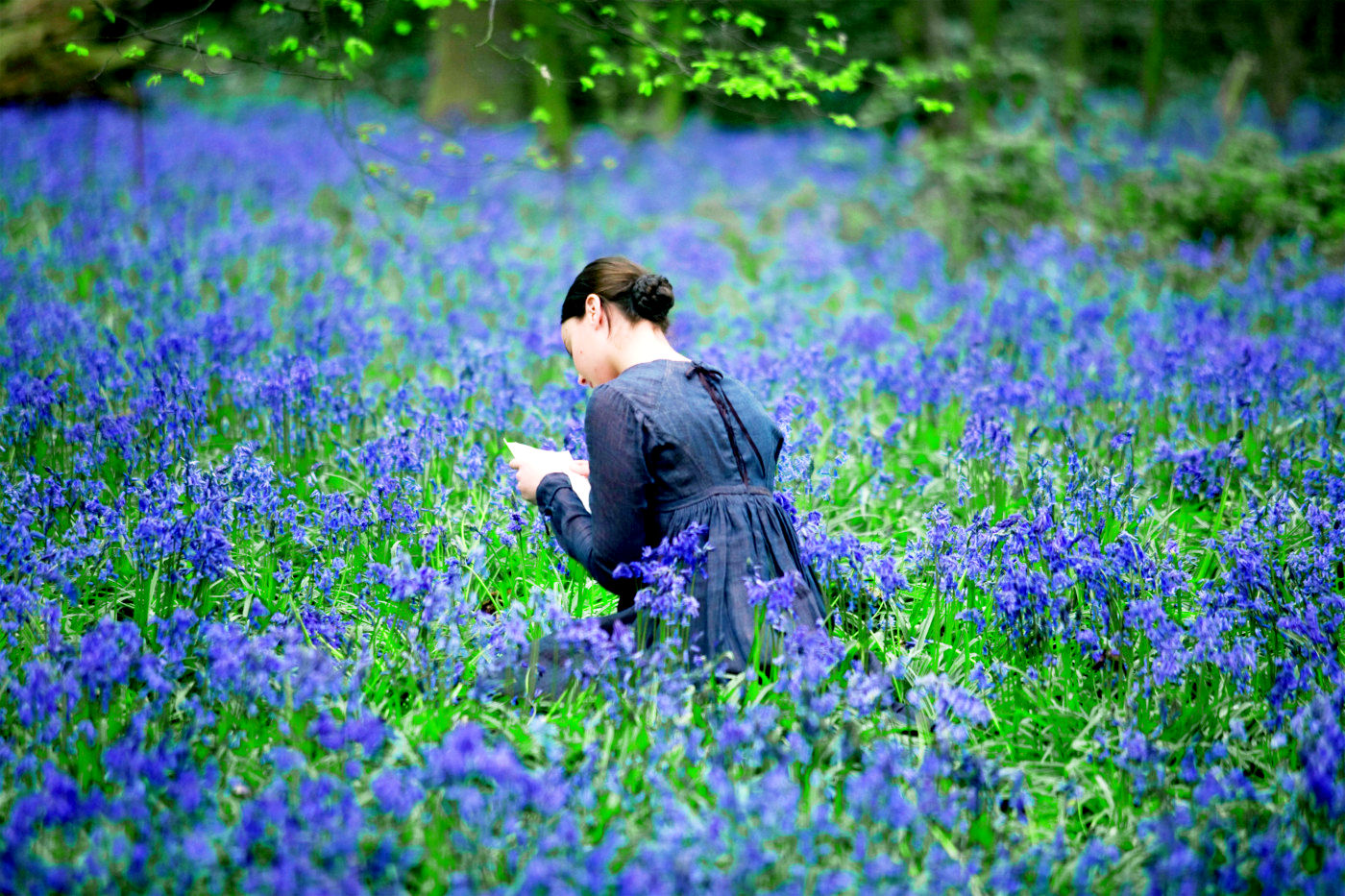
See what I'm talking about? The lush colors, the perfect framing, this movie would be romantic even without the great romance.


Abbie Cornish stars as Fanny Brawne in Apparition's Bright Star (2009)
Copyright © Apparition.

Sunday, October 4, 2009

bright star


"I cannot say forget me, but I would mention that there are impossibilities in the world."

Wrote John Keats to his love Fanny Brawne during one of the many separations they suffered through during their three year romance. Keats and Brawne are the subject of Jane Campion's new film Bright Star that focuses on Keats' poetry and relationship with Brawne. Though Keats has since become one of the most revered Romantic poets of all time (I had no clear recollection of his poems, though I'm sure I read them in high school), when he was alive he was painfully poor and lacking the social status needed to marry Brawne. And so their love is a tragic one, even before Keats becomes deathly ill.

I wanted to see Bright Star because I love another Campion film, The Piano, and had read glowing reviews of Bright Star. I was not disappointed. Keats' poems are integrated masterfully into the movie, and the cinematography is staggering in every single scene. The film spans three years, and every changing season appeared more beautiful than the last. Campion's captures of stark trees in winter and blooming flowers in spring fields were breathtaking.

The line I featured at the top of this post resonated with me as soon as I heard it. Brawne is loyal to Keats beyond normal romantic devotion, and her love for him is all-consuming. Their relationship is sad, and both actors do a great job of portraying it. Abby Cornish as Brawne is especially excellent, her crying scenes are believable and gut-wrenching, unlike so many unrealistic scenes of sobbing in movies.

So here is the trailer. Campion has made a movie that matches the grace and poignancy of the poetry it's about.


Friday, October 2, 2009

must it be? it must be!

The Unbearable Lightness of Being is one of those books that I will always return to and associate with a specific period of my life. I buried myself in it the fall of my senior year of high school and upon completing it, spent one very depressing evening in my basement watching the nearly three hour long film adaptation.

Every fall since I think of the story of Tomas and Tereza. The change in weather, the drop in temperature and the falling leaves remind of Kundera's philosophical musings on love and fidelity. Though I don't like the movie nearly as much as the book (it's too hard to translate all of those abstract ideas into a plot-driven film), I still think its trailer is one of the greatest ever made.

When I make my annual revisit to the novel, there is one part in particular that I read. It is the same section that I inevitably share with new people in my life. It is a very short chapter where Kundera breaks down everyone in the world into four distinct categories. As silly as I feel admitting that I demand people I am just getting to know to identify themselves as belonging to one of these four categories, I'd be lying if I said I didn't consider it a relatively accurate gauge of a person.

The chapter begins with this sentence: "We all need someone to look at us. We can be divided into four categories according to the kind of look we wish to live under."
I will give a brief synopsis of each type, only because I think classification is so much fun.

"The first category longs for the look of an infinite number of anonymous eyes, in other words, for the look of the public" This category usually contains celebrities and people seeking fame and public glory.

----

"The second category is made up of people who have a vital need to be looked at by many known eyes" These people, according to Kundera, are happier than the first category of people, because they can always come up with a large group of friends and acquaintances with whom they can interact and entertain.

----

"Then there is a third category, the category of people who need to be constantly before the eyes of the person they love." This is a dangerous category, and it is probably the one I belong in. I consider myself a combination of this and the next category...

----

"And finally there is the fourth category, the rarest, the category of people who live in the imaginary eyes of those who are not present" I think of this category often, when I am moving around, interacting with certain people in a certain way, or engaging in a behavior I know one person would have a strong reaction to... Usually the person I'm imagining in the same person who would be doing the looking in the third category.

It is a troubling combination at times.


So, which are you?